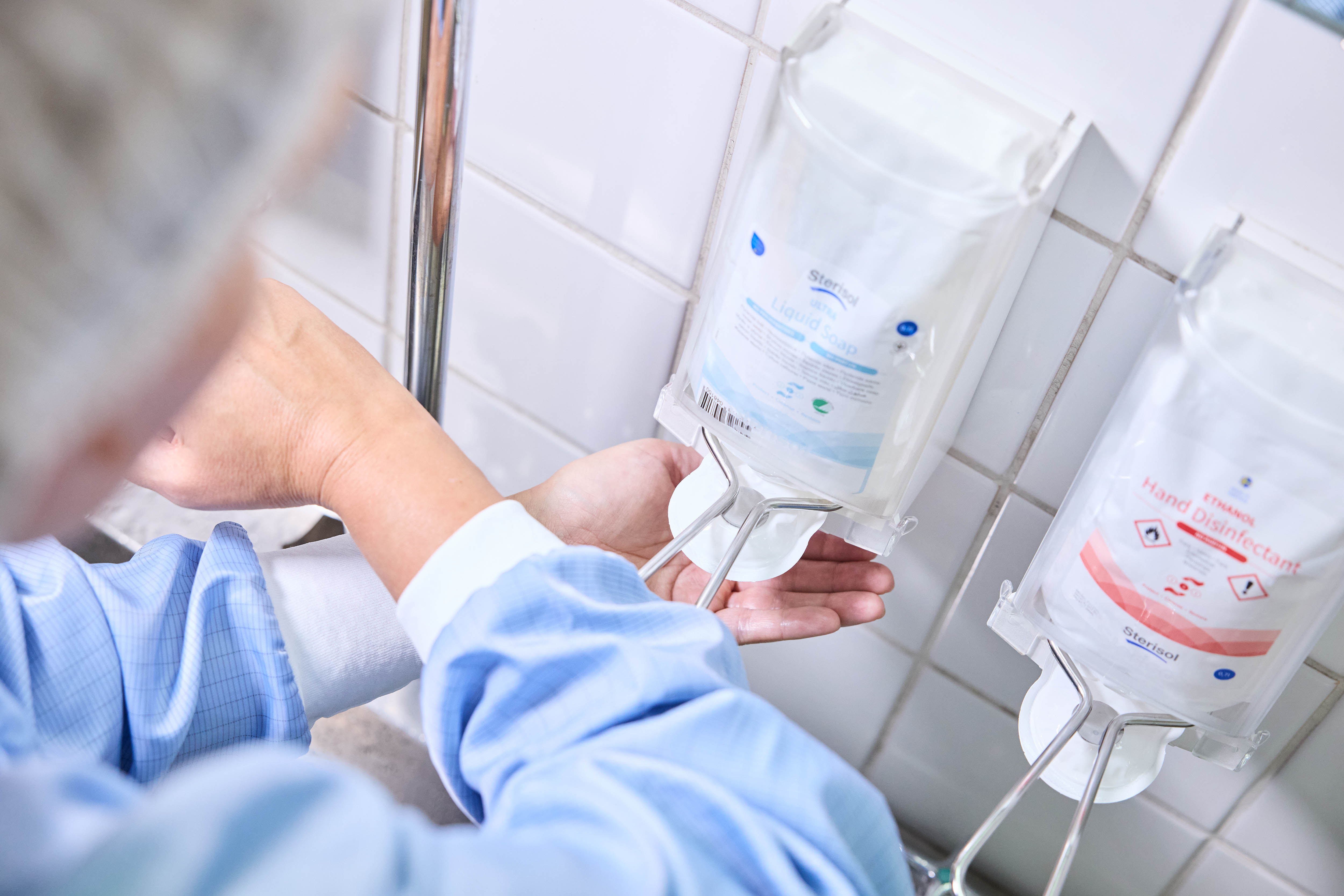
For hand sanitizer to function as part of an effective hygiene routine, it is important to choose the right product for your business needs and to use it correctly. Placement, dispenser solutions, and accessibility are also important factors in ensuring the product is easy to use in everyday life.
At the same time, hand sanitizer does not replace hand washing in all situations. Soap and water and hand sanitizer have different functions and complement each other depending on the task, hygiene requirements, and how the hands are soiled.
How does hand sanitizer work?
Hand sanitizer is used to reduce the amount of microorganisms on the hands and is an important part of hygiene routines in many businesses. Alcohol-based hand sanitizers work by inactivating microorganisms on the skin when the product is distributed thoroughly over the hands and allowed to act for the recommended time.
Hand sanitizer and hand washing serve different functions. Soap and water are primarily used to remove visible dirt and contaminants from the hands, while hand sanitizer is used to reduce the amount of microorganisms on clean and dry hands.
If hands are visibly or noticeably dirty, they must first be washed with soap and water. In businesses with specific hygiene requirements, hand sanitizer can then be part of the subsequent routine.
The need for hand sanitizer varies between different workplaces. In healthcare and elderly care, it is a central part of basic hygiene routines, but hand sanitizer can also be relevant in sectors such as food handling, industry, and other environments where good hand hygiene is important.
Can hand sanitizer dry out the skin?
It is common to associate alcohol-based hand sanitizer with dry skin, but properly formulated products do not have to be more drying than hand washing with soap and water. Many hand sanitizers contain moisturizing or emollient ingredients, such as glycerin, which help make the product gentler during frequent use.
With repeated hand washing, the skin is exposed to both water and cleansing agents, which can affect the skin's natural protective barrier. Therefore, alcohol-based hand sanitizer with moisturizing ingredients can often be a gentler alternative when hands do not need to be washed with soap and water.
If the skin is already dry, cracked, or irritated, the alcohol may sting upon application. This does not necessarily mean that the hand sanitizer is the cause of the skin problems, but it is important to take care of the skin and prevent further stress.
In workplaces where hands are frequently disinfected or washed, regular use of moisturising skincare can be a valuable complement. Sterisol's skin creams, such as SOFT Skin Creme, can be used as part of the skincare routine to add moisture and help the skin maintain its natural protective barrier.
Which businesses need hand sanitizer?
The need for hand sanitizer varies depending on the business, work tasks, and applicable hygiene requirements. In some environments, hand sanitizer is an obvious and recurring part of the workday, while in other businesses, it is used in specific situations or as a complement to regular hand washing.
When choosing hand sanitizer, it is therefore important to consider how and where the product will be used. Factors such as frequency of use, efficacy requirements, skin-friendliness, placement, and dispenser solutions can influence which product is the best fit.
It is also important that hand sanitizer is included in clear and functional hygiene routines. The product needs to be easily accessible where the need arises, and users need to know when to use hand sanitizer and when hands should be washed with soap and water instead.
Particularly in healthcare and elderly care, food handling, and certain parts of industry and production, hand sanitizer can be an important part of the business's overall hand hygiene.
Hand sanitizer in healthcare and elderly care
In healthcare and elderly care, hand sanitizer is a central part of basic hygiene routines and is used to reduce the risk of spreading infection between patients, care recipients, and staff. Since hands often come into contact with people, materials, and surfaces, hand hygiene needs to function as a natural part of daily work.
Hand sanitizer is used, among other things, before and after patient contact, before clean or aseptic work tasks, and after tasks where hands may have come into contact with contaminated material or bodily fluids. It should also be used after removing protective gloves when the situation requires it.
For routines to be easy to follow, hand sanitizer must be easily accessible where care work takes place. Dispenser solutions, placement, and the product's ease of use are therefore important parts of a functional hygiene solution.
Since hands may be disinfected many times during a workday, it is also important to choose a product suitable for frequent use and to supplement with skincare when needed.
Hand disinfection in industry and production
In industry and production, the need for hand disinfection varies depending on the operations, work tasks, and applicable hygiene requirements. In some environments, hand disinfection is a recurring part of the workday, while in others, it is primarily used in specific situations or in certain parts of the production process.
Hand disinfection can be relevant, for example, where many people share workspaces and equipment, where there are specific hygiene requirements, or where hands need to be disinfected between different work tasks. At the same time, it is important to remember that hand disinfection does not replace hand washing or hand cleaning when hands are visibly dirty or soiled with substances such as oil, grease, or other materials.
In industrial environments, different products often need to complement each other. Hand soap or more specialized hand cleaners can be used to remove dirt, while hand disinfection is used when the work task and the facility's hygiene routines require it.
By placing the right product in the right place and adapting the dispenser solution to the work environment, it becomes easier for employees to follow the facility's hygiene routines in their daily work.
Hand disinfection in food handling
In food handling, good hand hygiene is essential to reduce the risk of microorganisms and contaminants being transferred from hands to food, equipment, or work surfaces. Hand washing with soap and water is a fundamental part of hygiene routines, especially before handling unpackaged food and when hands are dirty.
Hand disinfection can be used as a supplement to hand washing when the facility's hygiene routines and work tasks require it. The specific need depends on factors such as the type of food being handled, how production is organized, and the hygiene requirements applicable to the operation in question.
For routines to work in practice, both hand washing and any necessary hand disinfection must be easily accessible where the need arises. Clear instructions and the correct placement of dispensers make it easier for staff to follow hygiene routines throughout the workday.
When choosing hand disinfection, it is also important that the product meets the requirements of the operation and is intended for the specific use case.
How to use hand disinfection correctly
For hand disinfection to be effective, it is important to use the right amount of product and distribute it thoroughly over the entire surface of the hands. The hand disinfectant should be worked into the palms, the backs of the hands, between the fingers, around the thumbs, and over the fingertips and nails.
For hygienic hand disinfection with Sterisol Ethanol, dispense approximately 3 ml into cupped hands. Rub the product thoroughly over the entire hands for at least 30 seconds until the hands are dry.
For surgical hand disinfection with Sterisol SENSE+, use a larger amount of product to ensure the hands remain moist throughout the application period. Dispense 6–9 ml and thoroughly work the product over the entire hands. The hands must be kept moist for 90 seconds, and the established protocol for surgical hand disinfection must be followed.
It is important that the entire skin surface is covered and that the product is allowed to act for the full recommended time. If too little product is used or certain parts of the hands are missed, the effectiveness may be reduced.
When using hand disinfection, the product's instructions for use and the facility's hygiene routines should always be followed, as the recommended amount and application time may differ between various products and areas of use.
Discover Sterisol's products for hand hygiene
Sterisol offers several products for professional hand hygiene, adapted for different operations, work environments, and hygiene requirements.
For hygienic hand disinfection, there is Sterisol Ethanol, developed for effective and straightforward use in professional environments. For operations with specific requirements for surgical hand disinfection, Sterisol SENSE+ is available.
At the same time, hand disinfection is only one part of effective hand hygiene. Sterisol's range also includes liquid soap for frequent hand washing, hand cleaners for more demanding dirt, and skincare for hands exposed to repeated washing and disinfection.
The products can be combined with the Sterisol System, where closed refill bags and dispensers in various sizes make it possible to tailor the solution to the facility's usage, placement, and requirements.
By combining the right products with a well-thought-out dispenser solution and clear routines, it becomes easier to create a hand hygiene standard that works in daily operations.